
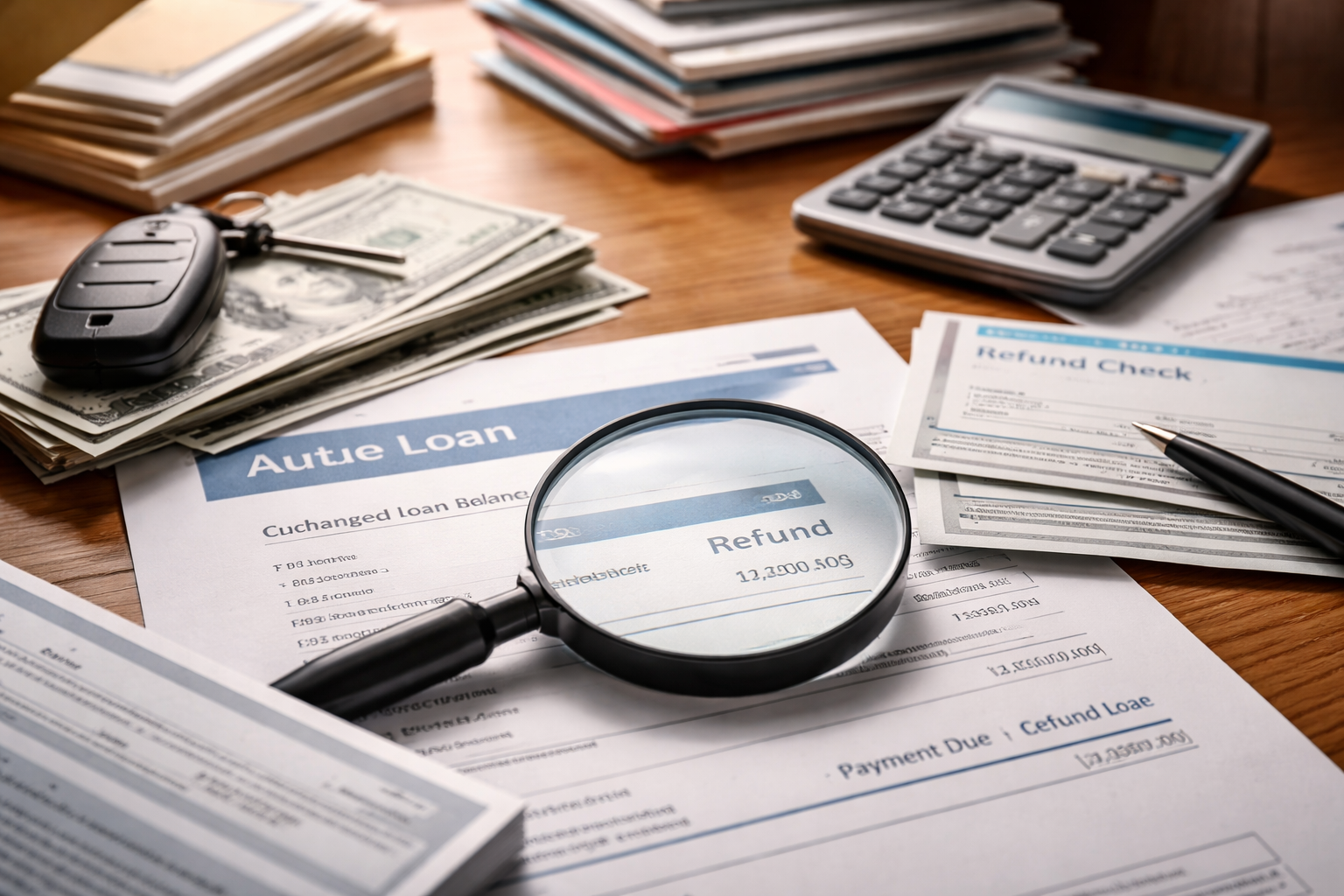
Dealer Cancelled Extended Warranty but Refund Not Applied to Auto Loan was the kind of problem that did not look serious at first. I had already signed the cancellation form. The finance office said the extended warranty was cancelled. The lender still showed the same balance. I checked the account again because I expected at least some movement in the principal, but there was nothing. Not a pending credit. Not a note. Just the same auto loan balance as if the cancellation never happened.
Dealer Cancelled Extended Warranty but Refund Not Applied to Auto Loan usually becomes visible in that exact moment: the paperwork appears finished, but the loan account does not reflect it. That gap matters because a cancelled warranty refund usually does not reduce interest or principal until the lender actually receives and posts the money. This is why many borrowers feel like the dealer is saying one thing while the lender is showing another.
If you want to understand how dealership financing breakdowns actually happen in real situations, this example helps connect the pattern:
This shows how deals that appear approved at the dealership level can still fail or misalign before reaching the lender.
Key Takeaways
- A cancelled extended warranty refund usually goes to the lender, not directly to the borrower.
- The dealer may submit the cancellation, but the warranty administrator or product provider often controls the refund release.
- The auto loan balance does not change until the lender actually posts the refund.
- Your monthly payment often stays the same even when the refund is correctly applied to principal.
- The most important question is not whether the warranty was cancelled, but where the refund stopped in the chain.
Why the loan balance often stays the same at first
Dealer Cancelled Extended Warranty but Refund Not Applied to Auto Loan is rarely an instant balance adjustment. In most financed vehicle deals, the extended warranty price was added into the amount financed when the contract was first signed. That means the refund does not behave like a retail-store refund. It does not usually go back to your debit card or appear as cash in your checking account. It normally has to move back into the loan.
That movement takes time because the money does not jump directly from the dealership screen to your lender account. The dealer may submit a cancellation request. Then the service contract company or administrator reviews the request. Then a prorated refund amount is calculated. Then the refund is issued to the lender. Then the lender receives it, matches it to the correct account, and posts it as a principal reduction. Until the last part happens, your statement may continue to look unchanged even if the cancellation has already started.
That is why many people are told the refund was “processed” while the loan still looks untouched. In dealer language, “processed” often means the paperwork was sent. In lender language, “processed” means the funds were received and posted. Those are not the same event.
What usually happens behind the scenes
Dealer Cancelled Extended Warranty but Refund Not Applied to Auto Loan follows a chain that is longer than most buyers expect. The finance manager or dealership business office usually starts the cancellation. But many extended warranties are backed by a third-party provider, not by the dealership itself. So the dealer often acts more like a submitting party than a paying party.
After submission, the provider looks at the contract terms, the cancellation date, mileage, claim history, and prorating formula. The refund amount may be lower than the original price because many products refund only the unused portion. Once the amount is finalized, the money is generally directed to the lender if the vehicle loan is still open.
From there, the lender still has work to do. Incoming funds have to be matched to the right borrower, contract number, and product cancellation record. If the lender receives incomplete identifying information, the refund can sit in a suspense or exception queue before posting. A large part of the delay is not about whether the borrower is entitled to the refund, but whether the incoming payment was correctly packaged and matched.
For a basic official explanation that extended warranties or service contracts are optional add-on products and can be cancelled during the term of the loan, see the CFPB’s guidance on optional add-on products and cancellation rights. :contentReference[oaicite:0]{index=0}
Where the refund usually gets stuck
Dealer Cancelled Extended Warranty but Refund Not Applied to Auto Loan usually breaks down at one of four points: the dealer never properly submitted the cancellation, the provider has not issued the refund yet, the lender received the refund but has not posted it, or the refund was applied in a way the borrower did not expect.
Here is the first branch that matters:
If the dealer says the cancellation was completed
- The next question is whether the provider approved and released the prorated amount.
- A completed form is not the same as a completed refund.
- Ask for the cancellation date, refund amount, and where the refund was sent.
If the provider says the refund was sent
- The next question is whether the lender received and posted it.
- Funds can sit unposted if the account number, VIN, or contract reference did not match cleanly.
- The lender may need time to move the refund from intake to principal application.
If the lender says nothing was received
- The cancellation may still be pending upstream.
- The refund may have been mailed or transmitted but not yet matched.
- The dealer’s “it was sent” statement may refer only to submission paperwork, not actual money movement.
If the balance changed less than expected
- The refund may have been prorated.
- Interest may have continued accruing while the refund was pending.
- The lender may have applied the refund to principal without changing the monthly payment amount.
Dealer Cancelled Extended Warranty but Refund Not Applied to Auto Loan becomes manageable only when you identify which of these paths fits your account.
Why your monthly payment may not drop
Dealer Cancelled Extended Warranty but Refund Not Applied to Auto Loan often causes a second misunderstanding after the refund finally posts. Many borrowers expect the monthly payment to go down. In many auto loans, that does not happen. The lender may apply the refund as a principal reduction while leaving the scheduled monthly payment unchanged.
That means the financial benefit can appear in a less obvious way. You may pay less interest over time, or the loan may pay off earlier, or the principal may shrink without a dramatic monthly statement change. A correct refund application can still look invisible if you are only watching the payment amount instead of the principal balance and amortization effect.
This is one reason people think the refund was never applied when it actually was. They are looking for the wrong sign. The right signs are usually a principal-only adjustment, an account history entry, or a reduced payoff amount.
When the dealership is still the real problem
Dealer Cancelled Extended Warranty but Refund Not Applied to Auto Loan sometimes sounds like a lender delay but is really a dealer paperwork problem. If the cancellation request was missing the correct contract number, odometer reading, borrower signature, or lender details, the provider may reject it or leave it pending without the borrower ever being clearly told.
In that situation, the finance office may still tell you the matter is “in process,” but the cancellation is not moving. This is especially common when the original sale involved multiple add-ons, a refinance, a payoff, a trade-in, or a different contract being sent to the lender than what the buyer thought was final. When the refund does not start, the issue is often not posting speed but defective submission.
This connects naturally with another financing problem page:
read this if the refund issue seems tied to mismatched paperwork, contract numbers, or finance-office document changes.
What your rights look like in practical terms
Dealer Cancelled Extended Warranty but Refund Not Applied to Auto Loan is not just a customer-service annoyance. It affects principal, payoff timing, and in some situations total interest paid. If the product was optional and was properly cancelled, the borrower generally has a reasonable expectation that the unused portion will be credited according to the contract terms. The exact timeline depends on the contract, state rules, and the entities involved, but the basic expectation is clear: the refund should not disappear into vague dealership language.
In practical terms, your strongest position usually comes from documentation, not argument. The cancellation form matters. The service-contract agreement matters. The lender account history matters. The refund amount and date matter. If a payoff happened before the refund posted, then a direct refund question may arise rather than a principal reduction question. If the loan is still active, the issue is usually whether and when the lender will apply it.
The borrower’s leverage gets much stronger once the conversation shifts from “you told me it was cancelled” to “here is the cancellation date, refund amount, and proof that the lender still has not posted it”.
What actually resolves this kind of dispute
Dealer Cancelled Extended Warranty but Refund Not Applied to Auto Loan does not usually get fixed by repeating the story over and over to different people. It gets fixed by tracing the chain precisely. That means confirming three things in order: first, the cancellation was accepted; second, the refund amount was issued; third, the lender received and posted it.
If one of those steps cannot be confirmed, that is the place where the matter is actually broken. A lot of borrowers lose time because they stay in the first conversation too long. The dealer says it was cancelled. The lender says they do not see it. The borrower goes back to the dealer. The cycle repeats. A more effective approach is to force the timeline into concrete points: cancellation submission date, approval date, refund amount, transmission date, and lender posting date.
Here is another branch that helps identify the right path:
If the loan is still open
- The refund usually belongs as a credit to principal.
- The key issue is whether the lender has received and posted it.
- The statement history and payoff amount matter more than the monthly payment amount.
If the loan was paid off or refinanced
- The refund may no longer fit neatly into the old loan ledger.
- The question becomes whether the unused amount should be sent elsewhere after the old balance closed.
- Old-account closure can slow down matching and disbursement.
If multiple add-ons were cancelled together
- One product may have refunded while another did not.
- The lender may post only one incoming amount first.
- The account can look partially corrected even though the full issue is unresolved.
Mistakes that quietly make the situation worse
Dealer Cancelled Extended Warranty but Refund Not Applied to Auto Loan often drags out because borrowers assume the cancellation alone is enough proof, or because they wait only for the monthly payment to drop, or because they do not separate dealer statements from lender records. Another common mistake is failing to notice that interest continued while the refund was delayed, making the eventual principal benefit look smaller than expected.
Some also assume that if the dealer is friendly and says the refund is coming, the paper trail can wait. That is risky. Friendly assurances do not move loan ledgers; documented dates and identifiable refund records do. The more time passes, the harder it becomes to reconstruct where the money stopped.
FAQ
How long does a cancelled extended warranty refund usually take?
It often takes several weeks because the process usually involves the dealer, a service-contract provider, and the lender. The visible delay usually comes from approval, issuance, or posting rather than from the cancellation form alone. :contentReference[oaicite:1]{index=1}
Does the refund go to me or to the auto lender?
If the auto loan is still active, the refund usually goes to the lender and is applied to the loan rather than paid directly to the borrower. That is why the issue often appears as a loan-posting problem instead of a missing check. :contentReference[oaicite:2]{index=2}
Will my monthly payment go down after the refund is applied?
Usually not. Many lenders apply the refund as a principal reduction while leaving the scheduled monthly payment unchanged. The financial effect may show up more in payoff amount or total interest than in the regular installment.
What if the dealer says it was cancelled but the lender shows nothing?
That usually means one of two things: the refund was not yet issued upstream, or it was issued but not yet matched and posted by the lender. The key is finding the exact step where the chain stopped.
Recommended Reading
When this problem turns into a broader contract or lender-record dispute, the next useful page is here:
useful when the refund issue starts looking like a larger breakdown between dealership finance records and lender account records.
Dealer Cancelled Extended Warranty but Refund Not Applied to Auto Loan is rarely a mystery once the chain is broken into parts. The cancellation itself is only the beginning. The refund still has to be calculated, transmitted, received, matched, and posted. The problem usually becomes clear the moment you stop asking whether it was cancelled and start asking where the refund is in that sequence.
Dealer Cancelled Extended Warranty but Refund Not Applied to Auto Loan is also distinct enough from your existing dealer pages to stand on its own. It is not mainly about forced warranty sales, warranty denial, or changed financing terms. It is about the post-cancellation money path between dealer, provider, and lender. That makes it a separate problem-solving article rather than a near-duplicate of the pages already on the site.