
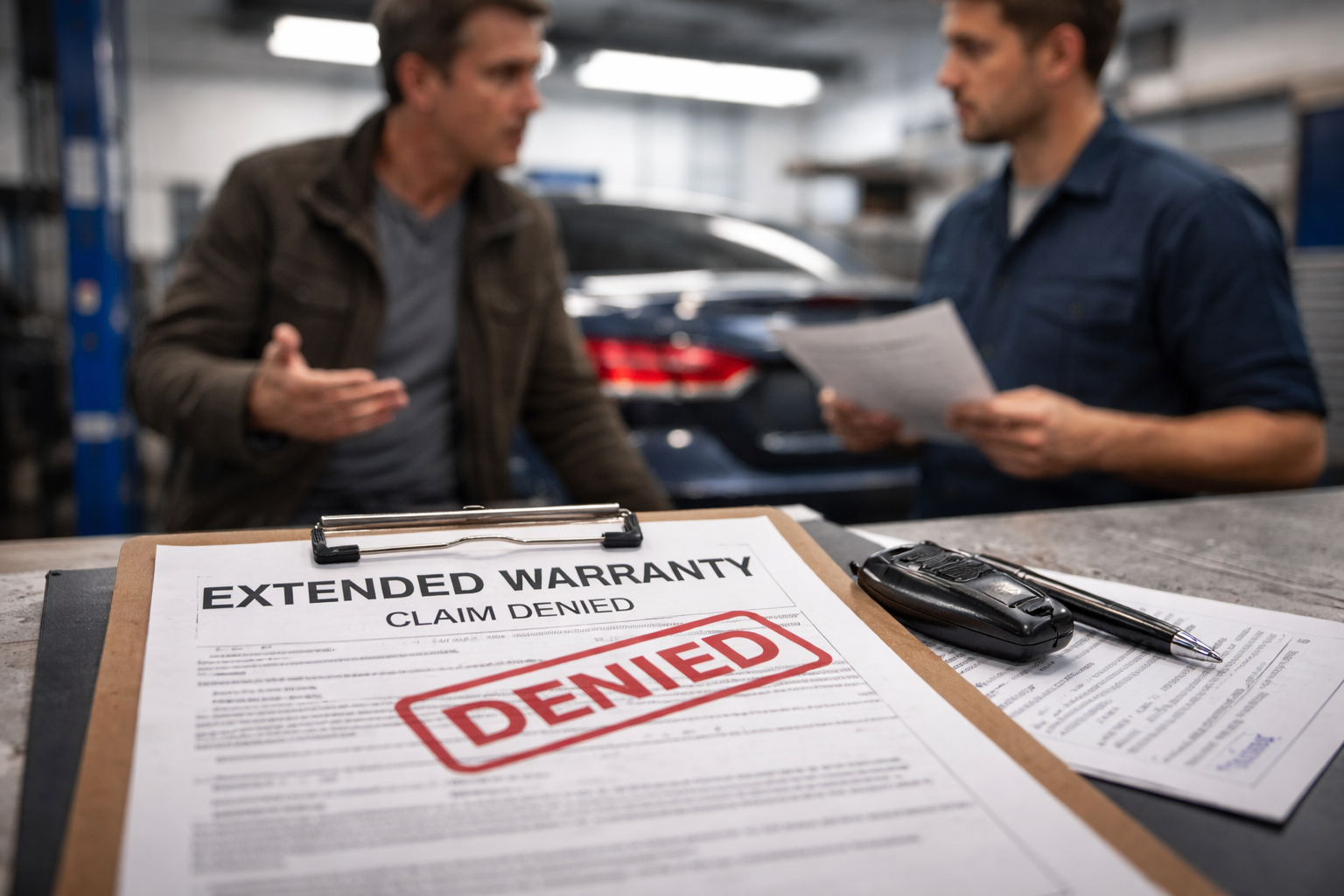
Extended warranty dispute with dealer usually starts with a sentence that feels too casual for how expensive it is: “This isn’t covered.” You’re standing at the service counter, you can hear the shop behind the door, and the advisor is already sliding the estimate toward you like the decision is final.
You remember why you bought the coverage in the first place. You didn’t want surprise repairs turning into financial chaos. Now the plan you paid for is being treated like it’s optional. This is the moment most people lose leverage—by authorizing repairs before the dispute is documented.
If you’re dealing with an extended warranty dispute with dealer, the most important thing to know is this: the first denial is often a starting point, not an ending. A lot of “not covered” answers collapse when you request written reasons, demand a claim review with the administrator, and control the paperwork timeline.
If the dealer flat-out refused to submit the claim or told you “there’s nothing we can do,” start there and come back—this page is your dispute playbook.
What This Dispute Is Really About
Most extended warranty dispute with dealer situations are not about whether your car is broken. Everyone agrees it’s broken. The fight is about classification:
- Is the failed part included or excluded?
- Is the failure “wear and tear” or a covered breakdown?
- Did maintenance “cause” the issue or is that just a convenient excuse?
- Does the administrator require a specific inspection or documentation?
Coverage disputes are won by documentation and timelines, not volume or anger.
60-Second Self-Check Before You Say Yes to Anything
- Do you have the contract name? (manufacturer-backed vs third-party service contract)
- Who is denying? Dealer, warranty administrator, or both?
- What exact component failed? (ask for the part name, not just “engine problem”)
- What is the denial reason in writing? If they won’t write it, that’s a red flag.
- Are you being pressured to authorize repairs today? Pressure often means they expect you to give up.
If you can’t answer these, you’re not ready to accept a denial.
Case Split: Match Your Dispute Type
Case 1 — “Not Covered” (Scope Dispute)
Dealer claims the failed part is excluded or not listed.
Case 2 — “Wear and Tear” (Interpretation Dispute)
Dealer claims the failure is normal aging, not a covered breakdown.
Case 3 — “Maintenance” (Eligibility Dispute)
Dealer says missing/late maintenance voids coverage.
Case 4 — “Pre-Existing Condition” (Timeline Dispute)
They claim the issue existed before coverage started.
Case 5 — “Administrator Denied” (Authorization Dispute)
The warranty company declined payment or needs more proof.
Case 6 — “Dealer Won’t Submit” (Process Dispute)
The service department refuses to open the claim at all.
Your goal is to pick the closest case and build a targeted file—not a general complaint.
Case 1: “Not Covered” (Scope Dispute)
In an extended warranty dispute with dealer, “not covered” often means one of three things: they’re reading the contract narrowly, they’re using a generic exclusion list, or they’re oversimplifying a part that actually falls under a covered system.
- Ask the dealer to state the exact failed component name and part number.
- Ask them to cite the contract section they’re relying on.
- Compare that with the “covered components” list and any “systems coverage” wording.
Vagueness is the enemy. Specific part names and written citations force accountability.
Case 2: “Wear and Tear” (Interpretation Dispute)
This is one of the most common extended warranty dispute with dealer patterns because it’s easy to say and hard for consumers to challenge without structure.
What you do next matters:
- Ask what evidence supports “wear and tear” (measurement, photos, inspection notes).
- Ask whether the failure is consistent with “premature failure” rather than normal aging.
- Request a second diagnosis in writing (even within the same dealer).
“Wear and tear” becomes weak when they can’t show objective evidence.
Case 3: “Maintenance” (Eligibility Dispute)
When an extended warranty dispute with dealer is based on maintenance, the argument often becomes emotional (“I did maintain it!”) and that’s where people lose.
Instead, build a clean file:
- Gather oil change receipts, service invoices, or dealership history printouts.
- If you used an independent shop, request a service summary email.
- Ask the dealer to identify the specific maintenance item they claim was missed—and how it caused the failure.
Even if you missed one interval, they still need to connect it to the failure—not just say it.
Case 4: “Pre-Existing Condition” (Timeline Dispute)
This case appears when the dealer suggests the problem existed before the contract started. In an extended warranty dispute with dealer, you counter with documentation of baseline condition.
- Ask for the purchase inspection report or intake inspection.
- Ask if the issue was documented on day one—if not, that helps you.
- If the vehicle was inspected at contract purchase, request that record.
If they can’t prove it existed earlier, “pre-existing” is often a weak narrative.
Case 5: Administrator Denied (Authorization Dispute)
Many extended warranty dispute with dealer cases are really disputes with the administrator—the company that actually decides whether the claim is paid.
Do this immediately:
- Ask for the claim number (or authorization request number).
- Ask what documentation is missing (be specific: notes, photos, diagnostics, teardown approval).
- Request a re-submission or escalation review.
- Ask whether a field inspector can be sent.
Administrators often reverse after a deeper review—especially if the dealer’s submission was thin.
Case 6: Dealer Won’t Submit the Claim
This is a frustrating form of extended warranty dispute with dealer because it blocks you before you even reach the administrator. Dealers sometimes avoid submitting claims they think will be denied, or they don’t want the administrative workload.
What to do:
- Ask for the service manager (not the advisor) and request claim submission in writing.
- Ask them to confirm in writing that they refused to submit—and why.
- Call the warranty administrator yourself and ask how to open a claim without the dealer.
A refusal to submit is not the same as a denial. It’s a process failure—and it can be corrected.
The “Documentation Trigger” Script (Use This Today)
Here is a message that works because it is calm, specific, and forces a paper trail in your extended warranty dispute with dealer:
Hello, before I authorize repairs, I’m requesting the denial reason in writing, including the exact contract section or administrator reason code being applied. If a claim has been submitted, please provide the claim number and the documentation requested for review. I would like this escalated for a coverage determination review.
This doesn’t threaten anyone. It forces structure.
What Not to Do (These Mistakes Cost You Leverage)
- Don’t authorize the full repair immediately “just to get back on the road.” Once paid, leverage drops.
- Don’t accept verbal explanations without written reason codes or citations.
- Don’t argue in general terms (“I paid for this!”). Argue component, clause, and timeline.
- Don’t skip the administrator if the dealer is the messenger. The decision-maker matters.
The system rewards the person who creates the cleanest paper trail.
Official Consumer Guidance (One Reliable Reference)
This official FTC resource explains how auto warranties and service contracts generally work and helps you stay grounded when coverage language gets confusing.
Key Takeaways
- extended warranty dispute with dealer is often a documentation and interpretation battle—not a final decision.
- The first “not covered” answer is frequently reversible after written citations and administrator review.
- Pick your case type and build a targeted file (scope, wear, maintenance, pre-existing, authorization, or refusal to submit).
- Do not approve major repairs until you’ve requested written reasons and claim numbers.
- Professional, structured communication creates faster escalation.
FAQ
Is an extended warranty dispute with dealer usually winnable?
Many are. Especially when the denial is vague, based on interpretation, or missing documentation. Outcomes improve when you act early and keep everything in writing.
Should I keep driving the car while disputing coverage?
If it’s unsafe, don’t. Safety comes first. If it’s driveable, document the symptoms and avoid changes that could complicate diagnosis.
What if they say “wear and tear” and won’t explain?
Ask for evidence, inspection notes, and a written denial reason. “Wear and tear” is weaker when it isn’t documented.
What if the dealer says the administrator denied it?
Ask for the claim number, reason code, and what documentation is needed for re-review. Administrator denials often reverse after escalation.
Final Action
An extended warranty dispute with dealer feels infuriating because it hits at the exact moment you need help. But you don’t have to accept a vague refusal as the final word.
Today, request the denial in writing, get the claim number, and force a coverage review based on contract language and documented diagnosis. Once you create a paper trail, the dispute stops being “your opinion” and becomes a process the dealer and administrator must respond to.
Do that now—before you authorize repairs—because timing is leverage. And leverage is what turns “not covered” into “approved after review.”