
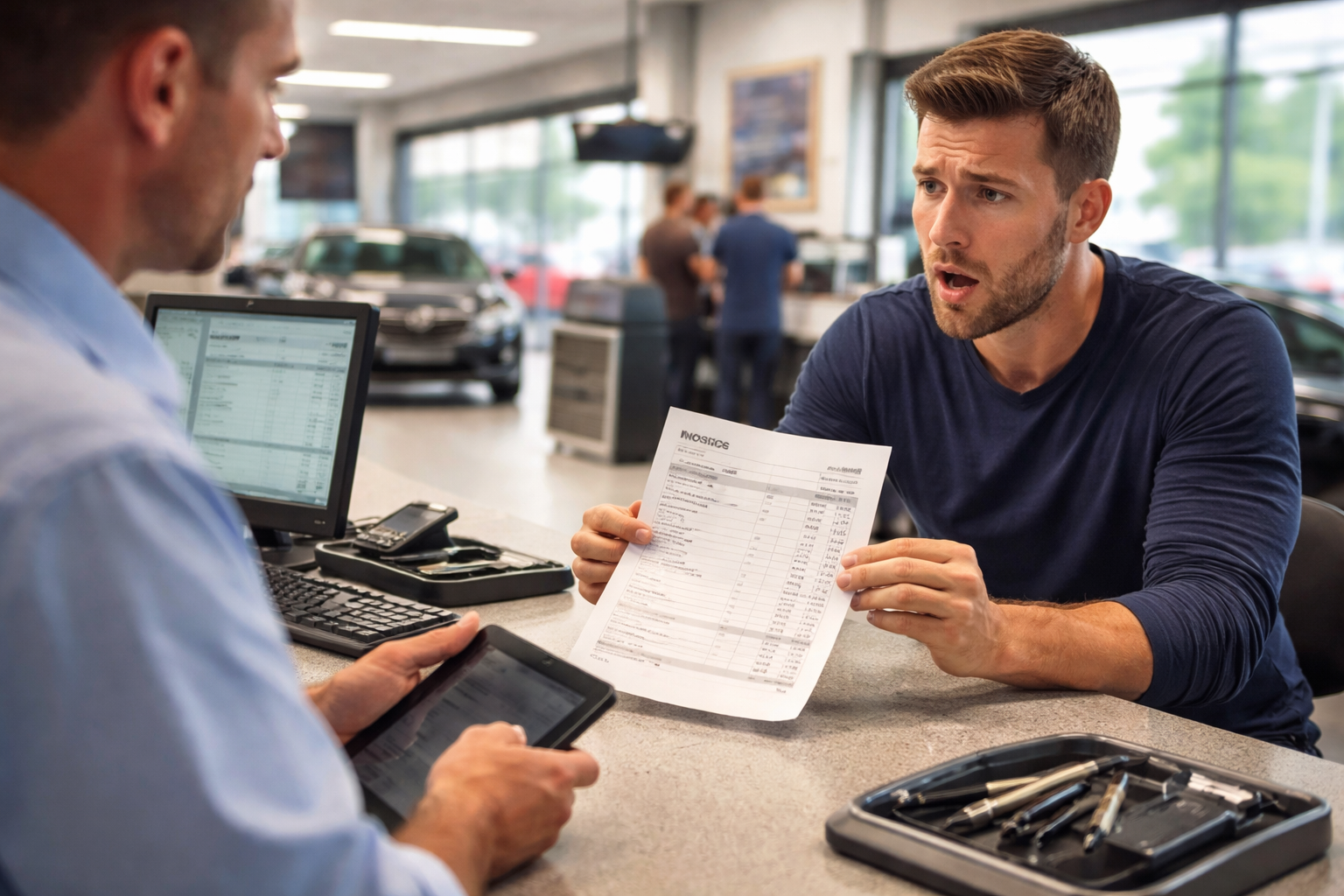
Service estimate different from final bill — I noticed it before I even looked up. The service advisor slid the final invoice toward me and kept talking, like the number on the page was normal. But it wasn’t. The total was hundreds higher than the written estimate I had approved. I reread the estimate line-by-line, then the invoice line-by-line, waiting for the “oops” moment. It never came.
I wasn’t angry yet. I was alert. The kind of alert you get when your brain realizes you’re about to lose money unless you slow everything down. I had a printed estimate with my signature. I had a time stamp. I had the original complaint written in plain language. And now the service estimate different from final bill problem was happening in real time inside a U.S. dealership service department, with my keys and my car sitting somewhere behind a locked door.
If you are in the lobby right now, do not pay yet. Your leverage is highest before you sign a revised total, before you authorize “just this once,” and before you let the dealership frame the difference as inevitable.
Read this if they’re already implying the extra charges are “your problem” and they won’t adjust.
What This Dispute Usually Looks Like in Real Life
Most people arrive at this moment the same way: you approved an estimate, you expected a predictable bill, and you planned your finances around that number. Then you’re told “additional issues were found” or “parts came in higher” or “labor ran longer.” The phrase changes, but the pattern is the same: service estimate different from final bill becomes a surprise you are expected to accept instantly.
Here’s the part that matters: the dealership’s explanation is not the same thing as your authorization. A higher final bill can be legitimate in some situations, but legitimacy depends on what you approved, what was disclosed, and what can be documented.
Fast self-check (30 seconds):
- Do you have a written estimate (paper, email, or portal screenshot)?
- Did you sign an authorization for a specific total or a range?
- Did anyone call or text you about added work before it was done?
- Does the invoice include new line items you never discussed?
If you answered “yes” to the estimate and “no” to the contact, you likely have leverage.
A Detailed Branch Box You Can Use at the Counter
Use this decision box to map your next move. It’s designed to stop the “pay now, argue later” trap that often ruins a service estimate different from final bill dispute.
Start here: Is the final bill higher than the written estimate?
1) If the increase is small (roughly under 10%)
Ask for a written explanation on the invoice and a manager’s initials. Make them document why the price changed.
2) If the increase is moderate (roughly 10–25%)
Ask for proof of attempted contact (call log, text record, voicemail note) and the specific authorization they claim you gave. Request the original repair order plus the revised repair order.
3) If the increase is large (25%+ or “hundreds more”)
Do not approve the revised total at the counter. Ask for the service manager. If they stall, ask for the general manager or dealer principal. Say you need a documented authorization review before any payment decision.
4) If they say “we can’t release the car unless you pay”
Stay calm and ask them to identify exactly what portion is undisputed (the amount you approved) and what portion is disputed (added work). Ask whether partial payment is possible. Ask for the policy in writing.
5) If they threaten storage fees
Ask when storage starts, the daily rate, and where it is stated in the paperwork you signed. Do not accept a verbal policy as final.
Why This Happens
In a dealership service department, the system is built around flow: intake, diagnose, approve, repair, deliver. The problem is that “approve” is often treated as flexible if the dealership thinks you’ll pay to get your car back. That is why service estimate different from final bill spikes at the exact moment you’re most time-pressured.
Common real-world triggers:
- They started “diagnostics” and converted it into repairs without clear authorization.
- They discovered additional parts needed and proceeded before reaching you.
- They substituted parts or added shop supplies and fees you did not discuss.
- They used flat-rate labor or “book time” that exceeds what you expected.
- They added “recommended” items as if they were required.
None of these automatically justify surprise billing without documented approval.
What the Dealer Will Say
When a service estimate different from final bill dispute starts, dealerships often rely on a few scripts:
- “The estimate is only an estimate.” This tries to make the written number feel optional.
- “You signed the authorization form.” This implies blanket permission for anything.
- “It was necessary for safety.” This tries to shut down debate quickly.
- “Our technician found more issues.” This pushes you toward accepting extra work as unavoidable.
Here’s what you say back (short, calm, and effective): “Please show me the written authorization for the added work and the time it was approved.”
That one sentence forces the dispute into documentation instead of emotion. Documentation is where you win a service estimate different from final bill situation.
Official Consumer Guidance (FTC)
For authoritative U.S. government guidance on auto repair rights and estimates, see the Federal Trade Commission’s official resource below:
The Documents That Decide Everything
Ask for these items, even if they act annoyed:
- The original written estimate (the one you approved)
- The repair order with your signature
- The final itemized invoice
- Any revised estimate (even if they claim it was “in the system”)
- Call/text log notes showing contact attempts
- Technician notes that justify additional work
If they refuse to print or email them, take photos. If you’re told “we can’t,” respond: “Then please write on the invoice that copies were requested and not provided.”
In many disputes, the difference between “I feel overcharged” and “I can prove unauthorized charges” is whether you collected these documents before leaving.
A Practical Fix Path That Works Without Drama
The goal is not to “win an argument.” The goal is to get an adjusted invoice or a documented dispute pathway while keeping the car and your credit safe.
Resolution steps (in order):
- Step 1: Ask for an itemized comparison: estimate line items vs invoice line items.
- Step 2: Circle what is new and ask: “When did I approve this?”
- Step 3: Request manager review with the original estimate in hand.
- Step 4: Offer a clean split: pay the undisputed amount now; dispute the rest in writing.
- Step 5: Send a short email the same day summarizing what happened and what you requested.
When you keep it structured, you look credible and the dealership has room to correct the bill.
If you pay by credit card, you may have additional dispute options depending on the facts. But the strongest move is still the same: get the record straight before payment, especially in a service estimate different from final bill scenario.
Mistakes That Quietly Destroy Your Leverage
- Signing a revised invoice without notes. If you must sign, write “Paid under dispute for unauthorized added charges” where allowed.
- Paying in cash. It reduces your documentation trail.
- Only complaining verbally. No paper trail means no pressure.
- Leaving without copies. Later you’ll be arguing from memory.
- Letting them frame it as your “misunderstanding.” Keep it about authorization and documentation.
A service estimate different from final bill dispute is often decided by what you did in the first 24 hours. Not by what you post online later.
A Self-Application Checklist
Use this checklist to instantly match the article to your situation.
- I approved a written estimate for $______ on (date/time): ______.
- The final bill is $______, which is higher by $______ (or ____%).
- New line items include: ______, ______, ______.
- I was contacted before added work was done: Yes / No.
- They can show proof of authorization: Yes / No.
- I requested copies of all documents: Yes / No.
- I escalated to a manager (name/title): ______.
- Next step I will take today: ______.
If you can’t fill in the blanks, your first task is to get the paperwork.
A Credible “Ask” That Gets Results
When you talk to the manager, don’t lead with “This is a scam.” Lead with structure:
- “I approved the written estimate for $X.”
- “The final invoice is $Y.”
- “Please show where I authorized the additional $Z.”
- “If there is no authorization, I’m requesting an adjustment to the approved amount or a documented dispute option.”
This language makes it easy for them to fix it without admitting wrongdoing. That matters because dealerships often resist anything that sounds like blame, even when they know the bill is shaky.
Key Takeaways
- Your signature on an estimate is a real anchor point.
- A higher bill is not automatically valid without documented approval.
- Winning means collecting documents and keeping the dispute structured.
- The best time to act is before you sign or pay.
FAQ
Is an estimate legally binding at a dealership?
It depends on state rules and what you signed, but dealers generally need authorization for significant increases. Focus on what was disclosed and documented.
What if they say the estimate had a disclaimer?
Disclaimers exist, but they do not automatically replace authorization. Ask for the exact clause and how it was applied to the added work.
What if the dealer says they tried to call me?
Ask for proof: call logs, text messages, voicemail notes, or the time stamp of attempted contact. In a service estimate different from final bill dispute, “we tried” should be verifiable.
Can they keep my car if I don’t pay the full amount?
Policies vary and state law matters. Your best move is to identify the undisputed amount and request a documented process for the disputed portion.
Should I pay and dispute later?
Sometimes that is the only practical option, but it reduces leverage. If you can resolve the authorization question before paying, do it.
Recommended Next Reading
If the bill ballooned because “recommended” items turned into “required,” this helps you spot the pressure tactics.
service estimate different from final bill issues feel personal because it hits the same nerve as any surprise charge: you did your part, you planned, you approved, and then the number changed anyway. But the fastest wins come from staying calm and getting specific.
Here is your immediate action plan: ask for the original estimate, ask for proof of authorization for added charges, and request manager review before you sign or pay a revised total. If they can document authorization, you decide whether the added work is acceptable. If they cannot, you push for an adjustment, partial payment of the undisputed amount, or a documented dispute pathway.
Do not leave the dealership without paperwork, photos, and names. In a service estimate different from final bill dispute, the record is your leverage.