
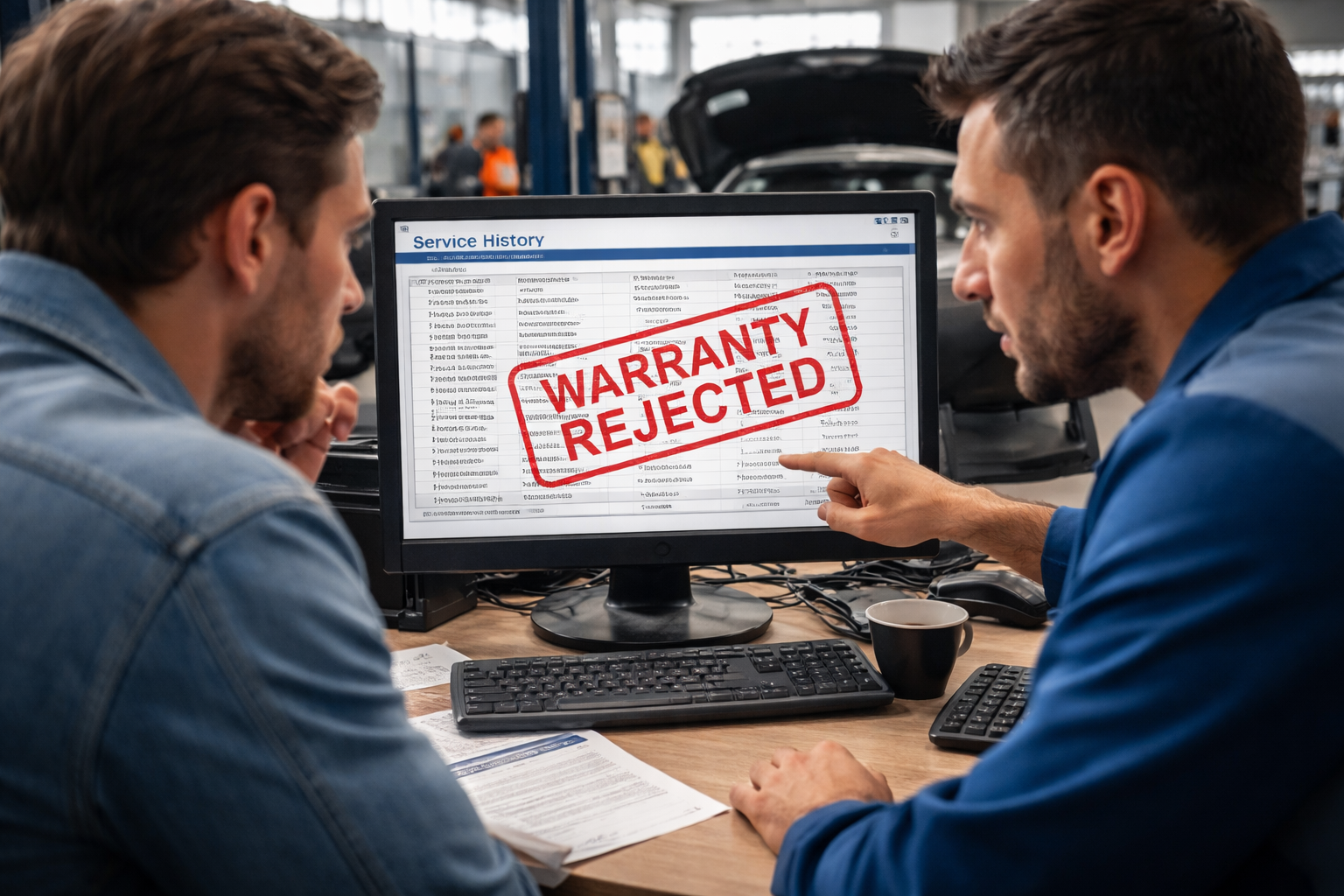
Dealer updated service history incorrectly causing warranty rejection was not the kind of problem I thought I would ever need to untangle. The moment it started, it did not look dramatic. I was standing at the service counter expecting a normal warranty update, and the advisor came back with that flat, rehearsed tone that makes you know something has already gone wrong in the system before anyone explains it. He said the claim could not move forward because the vehicle history showed missed maintenance. I knew that was not right the second he said it.
I did not argue right away. I asked him to print what they were looking at. That was when the real issue started to show itself. The mileage on one service entry did not make sense. One visit was missing. Another line looked like it was attached to the wrong time period. The problem was no longer just a denied repair. Dealer updated service history incorrectly causing warranty rejection had turned a routine service visit into a paper trail fight, and the denial was now resting on records that looked incomplete, misdated, or possibly entered under the wrong assumptions.
This article is built for the exact situation where the warranty problem is tied to the service record itself, not just a vague accusation that the owner “failed to maintain the car.” That difference matters because the solution path is different too.
If you want the broader financing and dealer dispute context first, this hub gives a wider map of how dealership record problems grow into bigger disputes.
Why this denial feels different
Dealer updated service history incorrectly causing warranty rejection usually hits harder than a normal repair disagreement because the denial sounds official. It sounds as if the system has already decided the facts. Many customers hear “your maintenance history does not support coverage” and assume the manufacturer database must be accurate. In real life, dealership service history can be incomplete, manually entered, delayed, attached to the wrong VIN, coded under the wrong operation, or never transmitted cleanly from one system to another.
That is why this kind of dispute often feels unfair from the first minute. You are not only being told “no.” You are being told “no” based on records you may not have seen until the denial happened. When the denial is built on bad service history, the first job is not debating the repair itself. The first job is freezing and correcting the record trail.
Quick self-check
If any of these sound familiar, this article fits your situation:
- The dealer says oil changes or required services are “missing,” but you know they were done.
- The mileage attached to a service visit looks wrong.
- A visit shows under the wrong date or wrong interval.
- Your records exist, but the dealer says they are not in the manufacturer system.
- A third-party shop performed maintenance, and the dealer is treating that as if no maintenance happened.
- The service advisor verbally admitted the history “may not have updated correctly.”
How records go wrong
Dealer updated service history incorrectly causing warranty rejection often starts with something small that later gets treated as decisive. A service writer may close a repair order with the wrong mileage. A maintenance line may be attached to inspection notes but not posted as a completed service item. A VIN may be one digit off in a system that was supposed to auto-fill. A prior visit may exist on paper but never sync to the manufacturer portal used for warranty review. A quick lube visit may be documented on an invoice, but the dealer reviewing the warranty claim may only trust records visible in its own screen.
Some disputes begin after ownership changes or service at multiple locations. A customer may have one oil change at the selling dealer, one at an independent shop, and another at a different franchise location. The vehicle was maintained, but the timeline appears fragmented. Then a powertrain, engine, transmission, or timing-related claim is submitted, and suddenly that fragmented record is treated as proof of neglect. Dealer updated service history incorrectly causing warranty rejection becomes more likely when the dealership treats missing visibility as missing maintenance.
There is also a more uncomfortable version of this problem: a dealership may enter the history in the way that best supports denial rather than in the way that best reflects what actually happened. That does not always mean outright fraud. Sometimes it is shorthand, sloppy coding, rushed closeout, or failure to reconcile old invoices. But the effect on the customer is the same.
For a related warranty fight where the dealer leans on maintenance as the reason for denial, this supporting article can help you compare language and pressure points.
The versions that matter most
When the missing entry is the real problem
If your maintenance was done at the same dealer and is still not showing, focus on internal correction. Ask for the repair order number, close date, mileage entered, labor operation used, and whether the record was transmitted to the manufacturer-facing system. In this version, the strongest argument is that the dealer already had the information and failed to maintain its own record chain properly.
When the mileage or date is wrong
If the interval looks broken because mileage or timing is wrong, the goal is to show the sequence is false. Pull invoices, inspection stickers, state inspection records if relevant, photos, payment timestamps, and any texts or emails confirming the visit. Even one wrong mileage entry can make an entire service schedule look missed when it was not.
When outside maintenance was ignored
If the car was serviced at an independent shop, the dispute shifts. You need dated invoices, mileage, service description, parts or oil specification if applicable, and payment proof. The dealer may act as though only dealer-performed maintenance counts. That is not automatically true. What matters is whether the vehicle was actually maintained to the required standard and whether the paperwork supports it.
When the dealer admits the record may be incomplete
This is one of the most important moments in the dispute. If anyone says the history “might not be updated,” “might not have crossed over,” or “might be missing in the system,” stop treating the denial as final. Ask for that statement in writing or send a follow-up email summarizing exactly what was said.
What the dealer will usually argue
Most dealers do not start by admitting the history is wrong. They usually narrow the issue and say the warranty administrator can only go by what is on file. They may say the records are incomplete, unverifiable, out of interval, or not sufficient for claim approval. That framing is strategic because it moves attention away from their input problem and toward your supposed lack of proof.
Another common move is to blend two separate ideas together: whether maintenance happened, and whether the repair is actually related to maintenance. Those are not always the same question. Even if there is a record gap, the dealer should not automatically treat every failure as maintenance-caused without connecting the alleged gap to the failed component. A warranty denial built on record defects should not be accepted as solid just because it was printed on dealership paper.
Customers often lose leverage by arguing in broad emotional terms. The better approach is narrower and sharper: identify the bad entry, identify the missing entry, identify the unsupported assumption, and force the record issue into writing.
What protects you fastest
Dealer updated service history incorrectly causing warranty rejection becomes easier to fight when you stop discussing it as one big unfair event and instead break it into verifiable points. Build a clean packet. Include the repair estimate or denial language, all maintenance invoices, card statements if needed, appointment confirmations, text messages, photos of mileage near service dates, and any prior dealer recommendations that match the maintenance timeline.
Then send a short written escalation to the service manager and, if needed, the general manager. Do not only call. Written language matters because it locks the issue into a record problem. Your message should say that dealer updated service history incorrectly causing warranty rejection, identify the exact entries that appear wrong or incomplete, and request immediate correction plus reconsideration of the warranty claim once the history is fixed.
You should also ask for these specific items:
- a complete printout of the service history they relied on,
- the repair order numbers tied to each recorded visit,
- the mileage and dates entered for each line,
- whether the manufacturer or warranty administrator has already received the denial basis,
- who entered or reviewed the service history before the claim was rejected.
The point is not to make the email dramatic. The point is to make it impossible for them to hide behind vague wording.
For official consumer guidance on warranties and related disputes, the FTC overview is a solid external reference.
Federal Trade Commission: Auto Warranties and Auto Service Contracts
Mistakes that weaken a strong claim
One of the biggest mistakes is letting the conversation stay verbal. Dealer updated service history incorrectly causing warranty rejection is exactly the kind of dispute that drifts when everyone says they are “looking into it.” If you do not create a written timeline, the denial can harden while the record error remains informal.
Another mistake is handing over original documents without preserving copies. Keep scans, PDFs, screenshots, and a clean chronology for yourself. Do not assume the advisor who seems helpful today will still be the one handling the file next week.
A third mistake is arguing only from fairness. Fairness matters, but warranty disputes are often decided by paperwork quality. You need to show that the record used to deny coverage was unreliable, incomplete, or wrong. That is stronger than simply saying you have always taken care of the vehicle.
And do not accidentally admit things that are not true just to keep the conversation moving. If someone says, “Well, maybe you missed one or two services,” do not nod along if the real issue is that their system failed to reflect them. Small concessions can later be treated as admissions.
Key Takeaways
- Dealer updated service history incorrectly causing warranty rejection is a records dispute first and a repair dispute second.
- Missing visibility is not the same as missing maintenance.
- Wrong mileage, wrong date, wrong VIN association, or unsynced repair orders can distort the entire service timeline.
- The fastest path is written escalation tied to exact record errors, not general complaints.
- If the denial rests on incomplete dealership history, ask for correction before accepting the rejection as final.
FAQ
Can a dealer deny warranty coverage just because their system does not show my maintenance?
They may try, but the absence of a visible entry does not automatically prove maintenance did not happen. The strength of your response depends on whether you can show invoices, dates, mileage, and a credible timeline.
What if the service was done at an independent shop?
That does not automatically destroy coverage. What matters is whether the maintenance was actually performed and whether your records support the interval, date, mileage, and type of service.
What should I ask for first?
Ask for the exact service history printout used to support the denial, including dates, mileage, and repair order references. Without that, you are arguing against a record you have not seen.
Should I keep speaking only with the advisor?
Not for long. If the issue involves inaccurate history entry, move it to the service manager quickly and use email so the disagreement becomes traceable.
Does one wrong entry really matter that much?
Yes. A single mileage or date error can make required maintenance appear late or missing, which can then be used to reject a claim that might otherwise have been covered.
Recommended Reading
If the denial is turning into a broader warranty fight, this article helps you compare how dealerships frame partial or shifting approval decisions.
Dealer updated service history incorrectly causing warranty rejection can make you feel as if the file is already closed before you even see the evidence. That feeling is exactly why many people back off too early. The denial looks polished, the service screen looks official, and the wording sounds final. But if the record underneath it is wrong, incomplete, or badly entered, the denial deserves to be challenged at the record level before it is treated as the truth.
The next move should be practical and immediate. Request the full service history they relied on, compare every date and mileage entry against your own records, and send a written correction demand to management the same day. Do not leave this as a phone conversation, and do not let them reduce the problem to “we just do not see it in the system.” If dealer updated service history incorrectly causing warranty rejection, then the first repair is the paper trail. Push that correction now, then force the warranty decision to be reviewed on the corrected facts.