
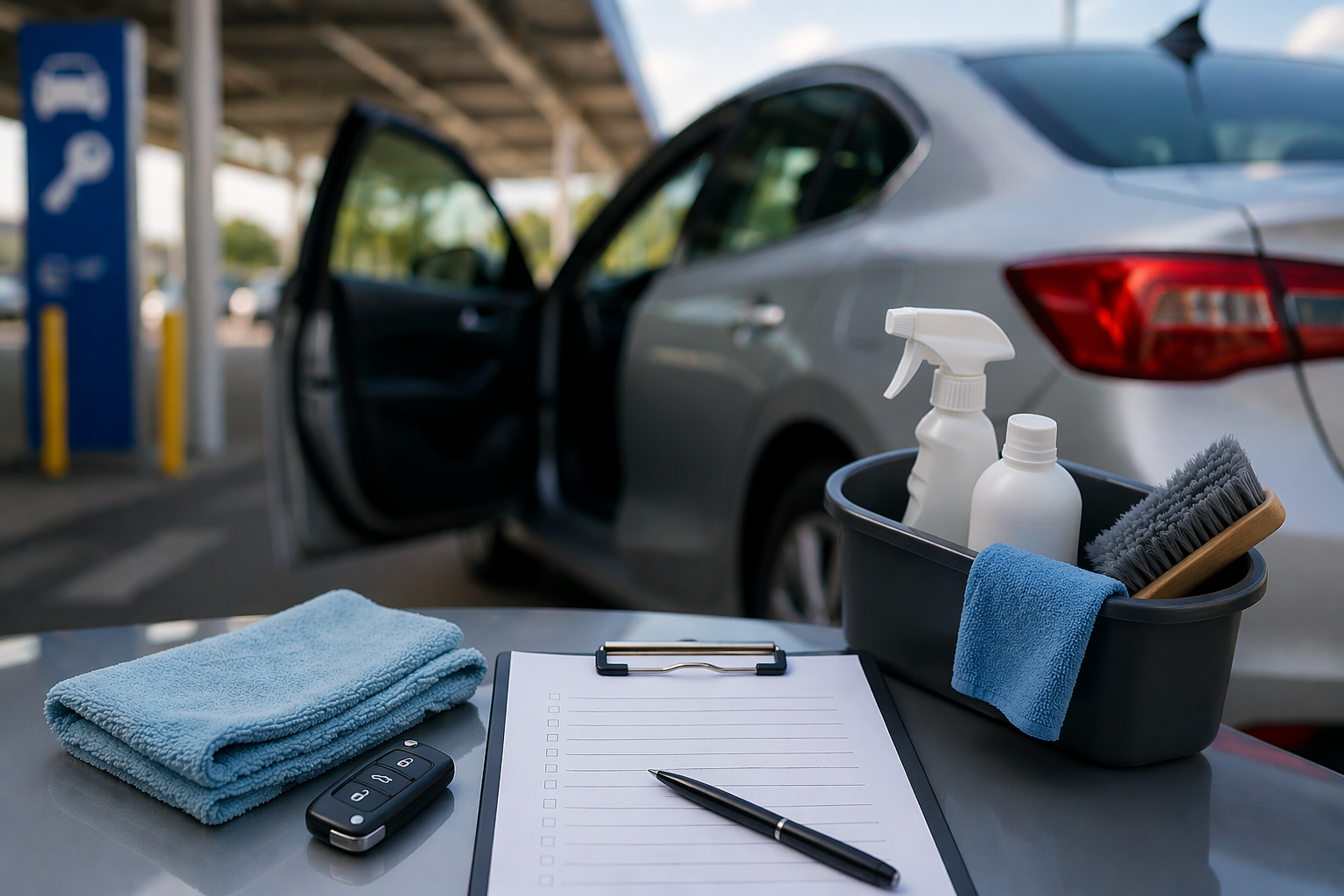
Rental Car Charged Cleaning Fee After Return is the kind of charge people usually notice only after the trip is already over. The car was dropped off, the keys were handed in, the counter interaction was short, and nothing was said about a problem. Then the receipt updates, the card statement changes, or an email arrives, and suddenly there is a cleaning charge attached to a return that looked routine at the time.
That is what makes this so frustrating. The problem usually does not begin when the car is dirty enough for a renter to notice it. It begins when the rental company applies its own inspection standard after the vehicle is already out of the customer’s hands. By the time Rental Car Charged Cleaning Fee After Return appears on the account, the discussion is no longer about what the renter saw at drop-off, but about what the company says it found later.
Before you get deeper into this issue, it helps to understand how related rental disputes are usually framed and documented. This background guide covers the broader pattern of charges that appear after return and helps put cleaning-fee disputes into context.
Why Rental Car Charged Cleaning Fee After Return Shows Up So Often
Rental Car Charged Cleaning Fee After Return has become more common because rental companies no longer rely only on what happens at the counter. Many returns are processed quickly, especially at airport locations, after-hours lots, and high-volume branches. The employee receiving the vehicle may only confirm that the car was returned, not whether it passes every cleaning standard. The detailed inspection often happens later, sometimes by another employee, sometimes in a separate staging area, and sometimes after the vehicle has already been moved for cleaning or re-rental preparation.
This timing matters more than most renters realize. When the inspection is delayed, the customer loses the ability to respond in real time. That creates a one-sided record: the company writes down what it says it found, but the renter was not there when that finding was recorded. That timing gap is one of the biggest reasons Rental Car Charged Cleaning Fee After Return becomes hard to challenge unless the renter asks for documentation immediately.
Another reason this happens more often is that “clean enough” is not a universal standard. One branch may ignore light sand on floor mats. Another may call it excessive debris. One employee may treat pet hair as normal wear from ordinary use if it is minimal. Another may classify the same amount as requiring specialized cleaning. So the problem is not always obvious neglect. Sometimes it is the company’s internal threshold being applied after the return is complete.
What Rental Companies Usually Mean by a Cleaning Fee
Rental Car Charged Cleaning Fee After Return does not always mean the car was returned in extreme condition. In practice, rental companies often use the term to cover several different situations. Sometimes it means visible dirt, food residue, mud, spills, smoke odor, pet hair, or heavy sand. Sometimes it means the company believes the vehicle needed extra labor before it could be rented again. Sometimes the fee is triggered not by visible mess alone, but by odor, moisture, staining risk, or contamination concerns.
The difference matters because many renters imagine a cleaning fee only applies to something dramatic, like a drink dumped on the seat or a car returned full of trash. In reality, the company may apply the fee for something much more subjective, such as a smell that staff describe as smoke-related, heavy sunscreen residue on interior surfaces, or pet hair that became visible only under bright lighting during lot processing. Rental Car Charged Cleaning Fee After Return often turns on a broad internal definition of “extra cleaning,” not on a customer’s common-sense definition of “dirty.”
How these charges are often classified internally:
Basic cleanup: light dirt or residue that staff say took extra time to remove.
Interior contamination: food spills, sticky surfaces, bodily fluids, sand buildup, mud, or wet upholstery.
Odor treatment: smoke smell, pet odor, mildew, or strong food odor that required deodorizing.
Specialized turnaround delay: the company says the car could not be immediately rented because cleaning took more than ordinary prep.
The Situations That Most Often Lead to Disputes
Rental Car Charged Cleaning Fee After Return becomes a real dispute when the renter and the company are talking about two different moments. The renter is thinking about the condition at drop-off. The company is often talking about the condition at post-return inspection. If those moments are separated by hours, staff changes, vehicle movement, or a transfer to another lot area, the disagreement becomes less about the condition itself and more about whether the company can tie that condition to the renter’s return with confidence.
One common situation is the quick airport return. The driver pulls into a busy lane, an employee scans the vehicle, and the renter leaves assuming that the transaction is complete. Later, the vehicle is moved to a holding area where another employee notes pet hair, sand, or odor and adds a cleaning charge. The renter never saw the inspection and never had a chance to respond.
Another common situation involves after-hours return. The renter leaves the car in a designated area, locks it, and drops the keys. The inspection happens the next morning. If the lot is exposed, if the car is moved, or if multiple returned vehicles are processed together, the renter is now arguing from memory while the company is arguing from its own internal record.
A third situation involves weather or trip conditions. A family returns from the beach, a ski trip, a road trip with kids, or a pet-friendly rental period believing they removed the obvious mess. But small sand deposits, fine pet hair, food crumbs under the seats, or lingering odor are later used to justify a cleaning fee. The renter sees ordinary use. The company sees nonstandard cleanup.
Patterns that usually turn a normal fee into a dispute:
– The car was accepted without comment, then charged later
– The return happened after hours, with no joint inspection
– The company will not provide photos or timestamps
– The fee description is vague, such as “cleaning” or “extra detail”
– The amount charged seems disconnected from what was allegedly found
– The vehicle may have been moved or handled by multiple staff before inspection was recorded
When Rental Car Charged Cleaning Fee After Return Looks Weak on the Company’s Side
Not every added fee is well-supported. Rental Car Charged Cleaning Fee After Return becomes much easier to challenge when the company cannot clearly connect the charge to a specific condition, time, and vehicle state right after return. If the only explanation is a generic line on a final receipt, that is weak. If the company refers to “policy” but cannot provide inspection photos, time records, or notes tied to the rental number, that is also weak.
The company’s position is strongest when it has clear, time-stamped photos, a contemporaneous inspection note, and a rental agreement clause allowing extra cleaning charges. Its position is weaker when the evidence is vague, delayed, or incomplete. If the company cannot explain what was found, when it was found, and why it required nonstandard cleaning, the charge starts to look more like an unsupported internal decision than a documented post-return condition.
This is especially true when the vehicle return was uneventful and the renter was never informed of a problem on site. A fee added later can still be valid, but the later it appears, and the less specific the supporting record is, the more reasonable it becomes to dispute it.
Official Reference:
Review how the Federal Trade Commission defines unfair or deceptive practices in automobile rentals and related charges
What Evidence Matters Most If You Want the Charge Removed
Rental Car Charged Cleaning Fee After Return is usually won or lost on documentation, not on how strongly the renter feels the car looked fine. That means the most useful evidence is practical and time-based. The strongest proof is usually clear drop-off photos or video showing the interior, floor area, seats, trunk, and dashboard right before return. A fuel receipt or airport parking timestamp can also help anchor the timeline, though it does not prove condition by itself.
If the renter has no photos, the dispute is still possible. In that situation, the focus shifts to what the company can prove. Ask for the exact reason for the fee, the amount, the inspection notes, all photos, the timestamps, and the location where the inspection occurred. If the company says the car required special cleaning, ask what specifically triggered that decision. General answers are not enough.
Another useful point is consistency. If the company says the issue was pet hair, do the photos show pet hair clearly? If the issue was smoke odor, is there any objective note beyond a generic statement? If the charge is high, does the record show what kind of cleaning was allegedly required? Rental Car Charged Cleaning Fee After Return becomes much easier to dispute when the company’s evidence does not match its own explanation.
For renters dealing with a post-return charge where the company seems to have little proof, this related guide is useful because it focuses on disputes built around weak documentation rather than obvious physical evidence.
What You Should Do in the First 24 Hours
Rental Car Charged Cleaning Fee After Return should be challenged as soon as it appears. The first 24 hours matter because that is when branch